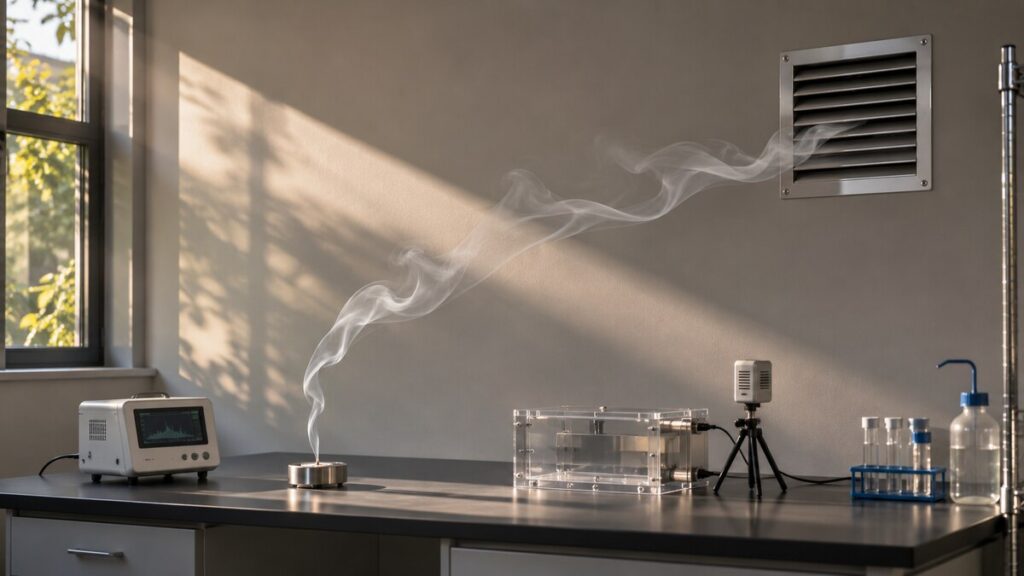
Six people smoked cannabis for an hour while six others sat nearby without smoking. In one session the room was sealed. In another, a ventilation system exchanged air with the outside. The research question concerned the people who never lit anything. Would changing the air supply make a difference that could be measured in their blood, in their descriptions of how they felt and in their performance on a brief task?
Giving the room an experimental role
The chamber study by Evan Herrmann and colleagues created unusually intense exposure under deliberately defined conditions. The room was small, several smokers were present at once and the observers stayed through the session. The ventilated condition used eleven air exchanges per hour. That figure describes airflow equivalent to eleven room volumes over an hour. It does not mean every molecule of old air departed before any new smoke entered.
Think about a smoke source that continues operating while fresh air enters. Smoke is being added, mixed, deposited on surfaces and carried away, all during the same period. With more outdoor air coming in, the concentration can be lower despite continuing emissions. The amount inhaled by a bystander depends on their exposure over time. An instantaneous photograph showing a hazy room is a poor substitute for that history.
Three ways of detecting a change
After the unventilated exposure, researchers detected cannabinoids in nonsmokers’ blood and urine. Participants reported sedative effects, and the investigators observed a small increase in heart rate and poorer performance on a task involving the substitution of symbols for digits. Under the ventilated condition the measurements showed substantially less exposure, without the same pattern of subjective or performance effects. The differences concern a defined set of measurements taken on the investigators’ schedule.
A companion analysis of oral fluid and blood helps explain why specimen type matters. Smoke contacts the mouth directly. A blood sample captures compounds that have entered circulation. Urine may contain products formed as the body processes an exposure. The timing and interpretation of a result therefore depend partly on which specimen went to the laboratory. One positive measurement is evidence about that specimen, not a complete account of a person’s experience.
Why one testing threshold changes the headline
A separate report on urine screening in the same research program examined results at different decision thresholds. A laboratory can detect an amount below the cutoff used to call a particular screening test positive. Lower the cutoff and more samples can cross it even though nobody in the chamber inhaled any additional smoke. A report that mentions only “positive” leaves this crucial part of the experiment out.
The three papers offer complementary views of a chamber study. They do not amount to three independent demonstrations in three unrelated populations. This matters because the original group was small and the unventilated exposure was conspicuous. A person sitting in dense smoke can see and smell what is happening. Expectation may influence a report of feeling sleepy in ways quite different from its influence on a blood measurement.
The air after the session
Ventilation reduced exposure in this experiment. A typical apartment, car or public space has a different volume, airflow pattern and number of smoke sources. Very few occupants know how many outdoor air exchanges are occurring, and an open window supplies no fixed experimental rate. Even an absence of detectable intoxication would leave a question about breathing combustion particles.
The US Environmental Protection Agency’s account of indoor marijuana smoke and the CDC’s overview of secondhand exposure address that broader concern. Keeping indoor spaces smoke-free avoids relying on an unknown ventilation rate to protect other occupants. What the chamber experiment contributes is a controlled comparison. The occupants in question had one role in each session. They sat in a room where other people were smoking. Changing the room changed their exposure.