At half an hour, fewer than half the participants who had smoked cannabis containing THC said they would drive. An hour later, more than two thirds said yes. They had good reason to notice a change in how they felt. The question confronting the researchers was whether their performance behind a simulated wheel had changed by the same amount.
Ask the driver before the drive
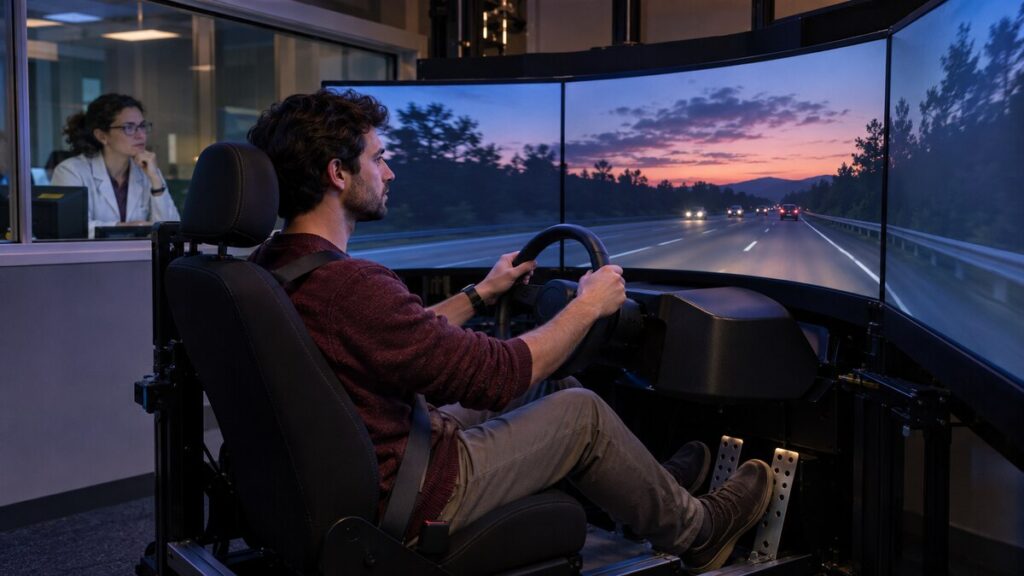
Thomas Marcotte and colleagues recruited regular cannabis users for a randomized trial of simulated driving. Participants received cannabis with THC or placebo and took a series of drives. Before driving they were asked about their own condition and willingness to drive. The simulator supplied an independent performance record. Asking first mattered because it captured the judgment that, outside the laboratory, someone might have to make before seeing how they actually performed.
Half an hour after smoking, 47.5 percent of the THC group said they would drive in their current state. At ninety minutes the proportion had risen to 68.6 percent. Meanwhile the group’s driving scores remained worse than placebo at both assessments. The size of the performance difference was similar at the two early time points. Willingness had moved substantially while the measured group disadvantage had scarcely moved.
Being more confident than an hour ago
There are at least two ways to read one’s own state. Someone might ask whether the strongest sensations have faded enough to feel more normal. Or they might ask whether their ability to handle a demanding journey has returned to baseline. The first comparison uses the period immediately after exposure as a reference. The second uses an ordinary sober day. A genuine improvement on the first scale need not be an accurate estimate on the second.
The trial cannot show what each participant thought about while answering. It measured their answers, not their private decision rules. Nor did every person in the THC group produce the same driving score. An average group difference can coexist with substantial overlap between individuals in the groups. The useful finding is the mismatch in the two curves over time. It would be an error to turn willingness at ninety minutes into a diagnostic test of impairment for a particular driver.
What a simulator can ask repeatedly
Repeated drives make it possible to compare the same people at several points without putting other road users in the experiment. The placebo group experiences waiting, repeated instructions and repeated exposure to the simulator too. That shared schedule helps distinguish effects of the substance from changes caused by practicing the driving task or simply growing tired of it.
An on-road trial of THC and CBD used a different approach, examining lane position during supervised highway drives. That measurement gains some realism and gives up some experimental freedoms. Researchers cannot repeatedly arrange for a pedestrian to step into traffic to see whether each driver reacts in time. A review of acute THC effects on driving-related abilities helps put the two approaches alongside a wider range of tasks, products and test times.
A disappearing group difference has limits
At the later assessments in the Marcotte trial the difference between groups was no longer statistically significant. That finding describes these participants, this route and the variation in the measurements. It cannot mark the instant at which every participant could safely make a real trip. In particular, this experiment tested smoked cannabis. It supplies no personalized timetable for a person who has consumed an edible.
Health Canada explains why there is no standard waiting time, and the CDC advises arranging transportation that does not depend on an impaired driver. Planning a ride before using cannabis removes the exact judgment the volunteers found difficult. The striking part of the experiment was not that people felt different after an hour. It was that a perfectly plausible feeling of improvement could arrive while a separate measurement was still telling much the same story as before.