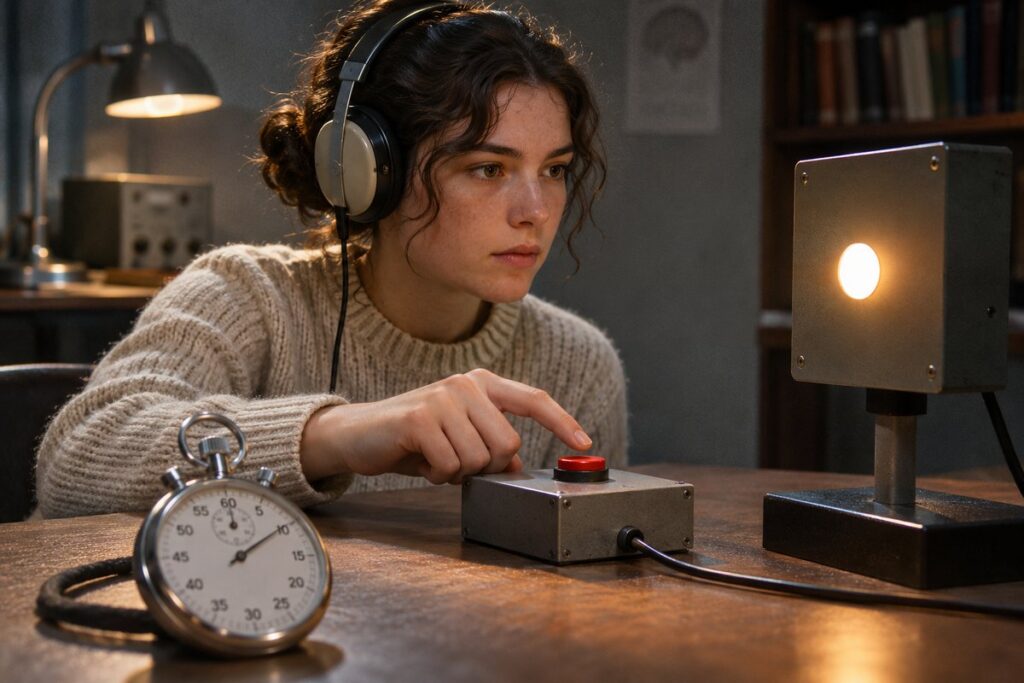
A light comes on. After a while it goes out, and you have to say how many seconds passed. Now try the reverse. Someone gives you a number of seconds, the light comes on, and you decide when to switch it off. The two games sound interchangeable until you imagine what happens when a second starts to feel unusually short. You might report too many seconds in the first game and switch off the light too soon in the second.
This reversal helps explain a curious finding from experiments with tetrahydrocannabinol, or THC. A person can overestimate and underproduce time in the same session. Put those two errors on a graph without explaining the instructions, and they look like evidence pointing in opposite directions.
Who gets to stop the clock?
In an estimation task, the experimenter controls the duration. Suppose a light stays on for ten seconds and an observer answers twelve. The observer has overestimated the interval by two seconds. In a production task, the observer controls the duration. Asked to produce twelve seconds, that same person might turn the light off when ten seconds have elapsed. The stopwatch shows an interval two seconds shorter than requested. These numbers illustrate the logic of the tasks, rather than a measured effect of THC.
One way to account for both errors is to imagine a counter accumulating subjective ticks faster than usual. During a fixed interval it collects extra ticks. When given a target, it reaches the required count early. A timing experiment can show whether answers fit that pattern. It cannot open the counter for inspection. Experimental work on how mental workload affects timing gives another reason to be cautious about this explanation. Attention wandering from the light, difficulty keeping the target in mind and an altered sense of passing time can all affect the button press.
What changed in the THC sessions
R. Andrew Sewell and colleagues studied short time judgments in 44 volunteers with different histories of cannabis use. Their data came from double-blind, placebo-controlled experiments in which THC was given intravenously. That route gave the researchers control over the timing of administration. Participants completed both types of timing task, and the design addressed a familiar shortcut: silently counting seconds to oneself.
Across the sample, acute THC tended to make participants overestimate elapsed intervals and produce intervals that were too short. The investigators also compared frequent and infrequent cannabis users. The changes were more evident among the infrequent users, while the groups did not show a clear baseline difference in time perception. A group average describes what happened across multiple trials and people. It supplies no conversion factor by which an individual’s watch could be corrected.
A long afternoon is a different experiment
The casual observation that time dragged at a party leaves out a crucial piece of information. Was the person attending to the time while the party was happening, or did the evening seem unusually long when recalled the next morning? A meta-analysis of duration judgments distinguishes these prospective and retrospective questions. Someone expecting a test can watch for time passing. Someone surprised by the question must reconstruct the interval with whatever memories are available.
A critical review of cannabis and time perception catalogued experiments that asked people to perform quite different timing tasks. The gap between a short laboratory interval and the length of a remembered evening gives a practical reason for that variation. The size of a laboratory effect also belongs to the conditions under which it was measured, including the route of administration and the point at which the volunteer was tested.
Even the phrase “count off a minute” quietly chooses a side in the experiment. It gives the participant a target and leaves the stopping decision in their hands. Ask instead how long the last minute lasted and the experimenter has already stopped the clock. Before deciding what THC did to anyone’s sense of time, it pays to know who had the switch.